Your first case study can feel like a mountain: history, assessment, investigations, care plan, drug study. The good news is that every college follows a similar nursing case study format. Once you know the sections and what goes in each, the work becomes steady and clear.
This guide walks through each section, shows a short sample, and lists the mistakes that cost students marks. Your college or university format comes first; use this to understand it, not replace it.
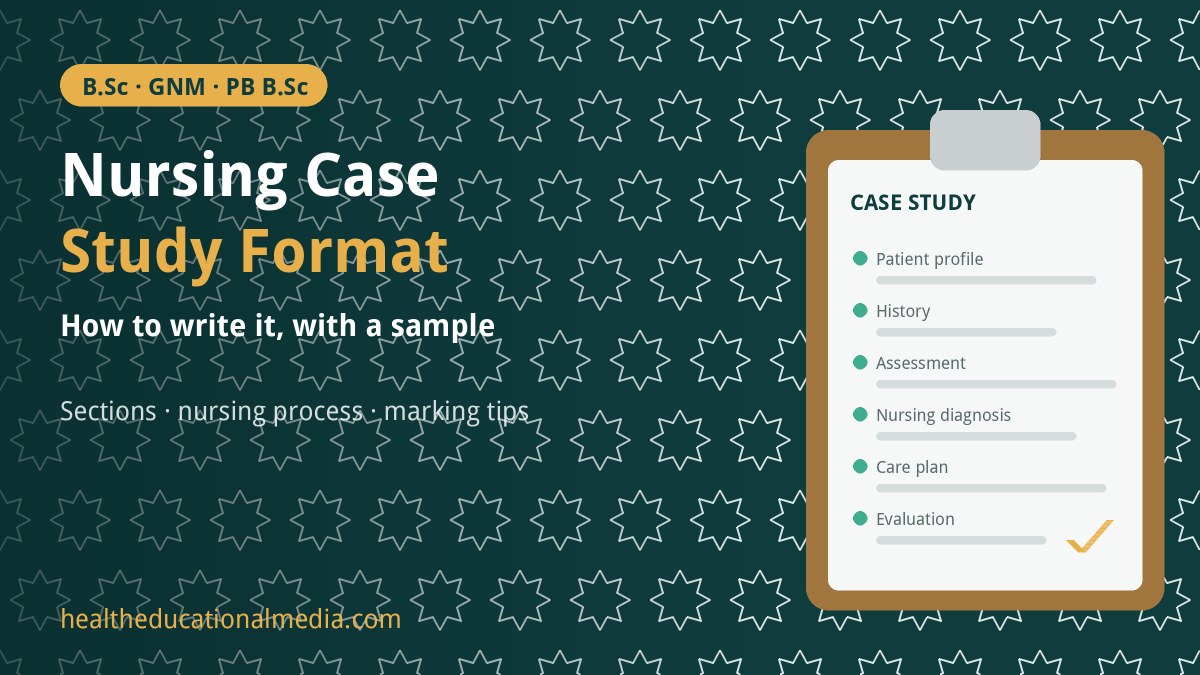
Table of Contents
What is a nursing case study?
A nursing case study is a detailed written record of one patient you cared for during your clinical posting. It links what the textbook says about a disease with what you saw in your patient, and shows how you applied the nursing process.
Clinical assignments such as care plans, case studies and case presentations are part of clinical evaluation in the INC revised B.Sc Nursing curriculum, and in GNM and Post Basic programmes too.
Nursing case study format: the sections
| # | Section | What to include |
|---|---|---|
| 1 | Introduction | Why you chose this patient; aim of the study |
| 2 | Patient profile | Initials only, age, sex, ward, bed, IP number, date of admission, diagnosis |
| 3 | Chief complaints | Main symptoms with duration, in the patient’s words |
| 4 | History | Present illness, past medical and surgical, family, personal, socio-economic |
| 5 | Physical examination | Vital signs and head-to-toe findings |
| 6 | Investigations | Test, patient value, normal range, interpretation |
| 7 | Disease condition | Book picture vs patient picture: causes, signs, pathophysiology |
| 8 | Management and drug study | Medical or surgical treatment; each drug’s action, dose, side effects, nursing responsibilities |
| 9 | Nursing process | Assessment, nursing diagnosis, goals, interventions with rationale, evaluation |
| 10 | Health education | Diet, medicines, follow-up, warning signs, discharge plan |
| 11 | Summary | Patient’s progress and what you learned |
| 12 | Bibliography | Textbooks and journals you used |
Sample: a short case study on pneumonia
Here is a shortened example for a fictional patient. A real case study goes into more depth in each section.
Patient profile and complaints
Mr. A, 62 years, male, medical ward. Diagnosis: community-acquired pneumonia (right lower lobe). Chief complaints: fever and productive cough for 5 days, breathlessness for 2 days.
Key assessment findings
- Temperature 38.6 °C, pulse 104/min, respiration 26/min, BP 128/82 mmHg
- SpO2 91% on room air
- Crackles over the right lower chest; thick yellow sputum
Nursing diagnoses and care plan
| Nursing diagnosis | Goal | Interventions (with rationale) |
|---|---|---|
| Ineffective airway clearance related to thick secretions, as evidenced by productive cough and crackles | Patient will clear secretions and have fewer crackles within 48 hours | Semi-Fowler’s position to ease breathing; deep breathing and coughing exercises to move secretions; oral fluids as allowed to thin sputum |
| Impaired gas exchange related to lung consolidation, as evidenced by SpO2 91% | SpO2 will stay at or above the target set by the doctor | Give oxygen as prescribed; monitor SpO2 and respiratory rate; report any fall |
| Hyperthermia related to infection, as evidenced by temperature 38.6 °C | Temperature will return to normal range | Monitor temperature 4-hourly; tepid sponging; give antipyretic and antibiotics as prescribed |
Evaluation: write what actually happened. For example: “On day 3, temperature 37.2 °C, SpO2 95% on room air, cough less productive. Goal partly met.”
How to write each part well
- Choose the right patient: someone you can follow for several days, with a condition from your syllabus.
- Collect data daily: note vitals, findings and changes every shift, not at the end.
- Compare book and patient: mark which textbook signs your patient had and which were absent.
- Write diagnoses in a clear format: problem, related to cause, as evidenced by signs.
- Give a rationale for every intervention. Teachers look for the “why”.
- Keep it neat: headings, tables and a contents page make checking easy.
Patient privacy: use initials, never the full name, address or photographs. Keeping a patient’s information safe is part of the trust (amanah) placed in every nurse.
Common mistakes that cost marks
- Copying the whole disease chapter instead of comparing it with your patient
- Writing medical diagnoses (“pneumonia”) where nursing diagnoses are needed
- Interventions with no rationale
- Evaluation that only says “goal met” with no data
- Investigation values without normal ranges
- Drug study copied from a list, not linked to your patient
- Missing bibliography
Case study vs case presentation vs care plan
| Assignment | What it is |
|---|---|
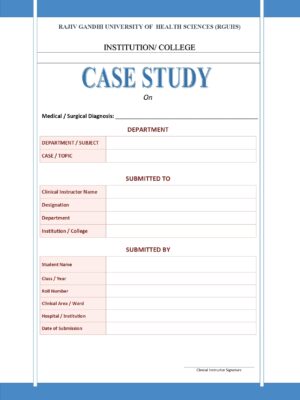
| Case study | A full written report on one patient, using the nursing case study format above |
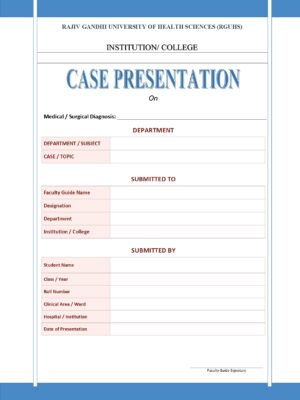
| Case presentation | An oral presentation of the same kind of case to your group and teacher, usually with charts or slides |
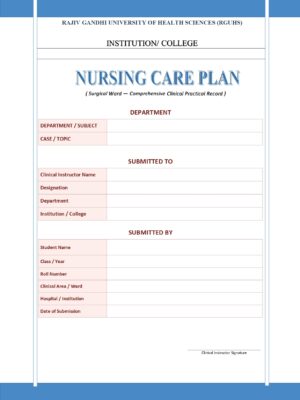
| Nursing care plan | A focused plan of nursing diagnoses, goals, interventions and evaluation; it forms one section of a case study |
Revise the basics first: nursing assessment, diagnosis and the nursing process, nursing documentation methods and vital signs.
Ready-made formats
Save time on layout and focus on your patient with these formats from the Health Educational Media marketplace:
- Nursing Case Study Format (B.Sc Nursing)
- Case Study Format (GNM)
- Nursing Case Presentation Format (B.Sc) and Case Presentation Format (GNM)
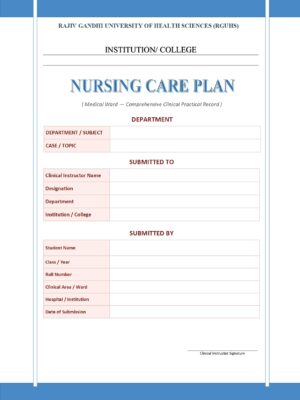
- Nursing Care Plan (Medical Ward) Format
Frequently asked questions
What is the format of a nursing case study?
A typical nursing case study format has: introduction, patient profile, chief complaints, history, physical examination, investigations, disease condition, management and drug study, nursing process, health education, summary and bibliography.
How many nursing diagnoses should a case study have?
There is no fixed number. Most students write 3 to 5 priority diagnoses, ordered by urgency. Follow your college’s guideline.
Can I use the patient’s real name?
No. Use initials only and leave out addresses, photographs and other identifying details.
What is the difference between a case study and a case presentation?
A case study is a written report; a case presentation is an oral presentation of a case to your group and teacher.
Pick your patient early, write a little every day, and your case study will almost write itself. Good luck with your clinical posting.
You May Also Read

AI Course for Nurses: INC-Accredited Programme with 60 CNE Hours Explained
INC has announced a 6-month Professional Development Program in Artificial Intelligence for Nurses with 60 CNE hours. Here is what we know, what is still unclear, and how nurses can use AI safely.
NORCET 12 Study Plan: 24-Week Preparation Timetable for April 2027
A week-by-week NORCET 12 study plan from 26 October 2026 to the Stage I exam on 10 April 2027, with daily routines, mock test schedule and a Stage II bridge plan.
PGIMER Nursing Officer Exam Date 2026: New CBT Date and 4-Week Revision Plan
The PGIMER Nursing Officer exam date 2026 is now 18 November (afternoon shift). Check the exam pattern, vacancies, selection process and a 4-week revision plan.
NORCET 11 Choice Filling 2026: How to Pick Your AIIMS Smartly
NORCET 11 choice filling runs from 30 October to 6 November 2026 (5 PM). Here is how institute allotment works, how to rank your AIIMS preferences, which documents to keep ready and the mistakes to avoid.