Why Vital Signs are the First Skill of Nursing
Vital signs — temperature, pulse, respiration, blood pressure (and increasingly, oxygen saturation and pain) — are the very first clinical skill a nursing student is taught. They are also the most tested skill in internal and university exams throughout the 1st semester B.Sc Nursing and 1st-year GNM programmes. Every subsequent nursing procedure — from oxygen therapy to medication administration — starts with reading and interpreting these numbers correctly.
Why Accuracy Matters Clinically
Studies published in the British Medical Journal and Nursing Standard have repeatedly shown that early-warning scoring systems (NEWS2, MEWS) — which rely entirely on vital signs — can predict clinical deterioration 6–24 hours in advance. A single mis-recorded respiratory rate can delay a sepsis diagnosis. For nurses in Indian hospitals following NABH accreditation standards, documenting vital signs correctly is not optional — it is a patient-safety and medico-legal requirement.
Normal Ranges at a Glance
- Body temperature: 36.1–37.2 °C (97–99 °F) oral — variations by site.
- Pulse: 60–100 beats/min in adults; 100–160 in infants.
- Respiration: 12–20 breaths/min adults; 30–60 in newborns.
- Blood pressure: < 120/80 mmHg (optimal, per JNC-8/ACC-AHA).
- SpO2: 95–100% on room air.
What This Unit Will Cover
The chapter walks you through each vital sign in a uniform structure: definition → physiology and regulation → factors affecting → assessment technique (sites, equipment, procedure) → alterations and nursing management. Special emphasis is placed on fever/pyrexia (stages, types, hot & cold applications) and documentation on the TPR chart, since both are routinely asked in both theory and practical/viva exams.
✅ “Get detailed 6th unit notes on vital signs for 1st semester B.Sc Nursing students. Covers temperature, pulse, respiration, blood pressure, and documentation.”
6th Unit Vital Signs Notes for 1st Semester B.Sc Nursing Students
| Chapter Section |
|---|
| Guidelines for Taking Vital Signs |
| Body Temperature |
| – Definition, Physiology, Regulation, Factors Affecting |
| – Assessment: Sites, Equipment, and Technique |
| – Temperature Alterations |
| – Fever/Pyrexia: Definition, Causes, Stages, Types, and Nursing Management |
| – Hot and Cold Applications |
| Pulse |
| – Definition, Physiology and Regulation, Characteristics, Factors Affecting Pulse |
| – Assessment: Sites, Equipment, and Techniques |
| – Alterations in Pulse |
| Respiration |
| – Definition, Physiology and Regulation, Mechanics of Breathing, Characteristics, and Factors Affecting Respiration |
| – Assessment of Respiration: Techniques |
| – Arterial Oxygen Saturation |
| – Alterations in Respiration |
| Blood Pressure |
| – Definition, Physiology and Regulation, Characteristics, and Factors Affecting Blood Pressure |
| Documenting Vital Signs |
OSCE & Viva Preparation Tips
- Know pulse sites: radial, carotid, brachial, femoral, popliteal, posterior tibial, dorsalis pedis, temporal, apical.
- Count respiration without telling the patient — conscious counting changes the rate.
- Use appropriate cuff size for blood pressure (width = 40% of upper-arm circumference).
- Define & differentiate — tachycardia, bradycardia, tachypnoea, bradypnoea, hypertension, hypotension, pulse pressure, pulse deficit.
- Document on the TPR chart in appropriate colours: red for temperature, blue/black for pulse, green for respiration.
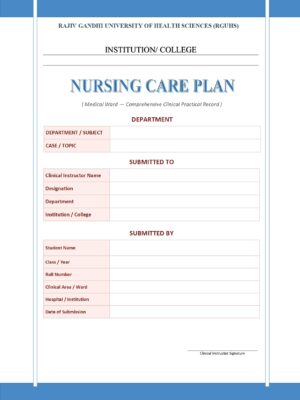
Combine these notes with our ready-made Vital Signs practical record, OSCE checklists and viva flashcards designed for 1st-year B.Sc and GNM students.
Sources & References: Potter & Perry, Fundamentals of Nursing (latest edition); Indian Nursing Council B.Sc Fundamentals of Nursing curriculum; NABH 5th edition patient-safety standards.
COURSES
Educational Disclaimer
The information in this article is provided for educational and informational purposes only, aimed at students and faculty in Nursing, Medical, Paramedical, and allied Health Science programmes. It is not medical advice, diagnosis, or treatment, and must not replace guidance from a qualified physician, nurse, or licensed healthcare professional.
While we review all content carefully and align it with recognised syllabi (INC, RGUHS, state nursing councils), medical knowledge evolves rapidly. Always verify clinical procedures, drug doses, and protocols against your institution's current guidelines before applying them in patient care.
For complete terms, see our Disclaimer. Found an error? Let us know.
You May Also Read
National Newborn Week 2026: Essential Newborn Care Every Nurse Should Know
National Newborn Week is 15–21 November. A simple guide to essential newborn care: the first hour, warmth, breastfeeding, vitamin K, birth vaccines, HBNC visits and danger signs.
Diabetic Foot Care Nursing: Assessment, Risk Levels and Patient Teaching
A practical diabetic foot care nursing guide: IWGDF risk categories, how to assess the foot, the monofilament test, daily self-care teaching and when to refer.

Honey for Wound Healing: Tibb-e-Nabawi Wisdom and Modern Nursing Evidence
What the Qur'an and Sunnah say about honey, what the Cochrane review found about honey for wound healing, and the safety rules every nurse must follow.
Nursing Case Study Format: How to Write One, with a Sample and Common Mistakes
A clear nursing case study format for B.Sc, GNM and Post Basic students: every section explained, a short worked sample on pneumonia, marking tips and common mistakes.