A small cut that a person with diabetes cannot feel can become an ulcer, an infection and, in the worst cases, an amputation. Good diabetic foot care nursing stops that chain early: regular assessment, simple daily habits and quick action on warning signs.
This diabetic foot care nursing guide follows the International Working Group on the Diabetic Foot (IWGDF) 2023 prevention guideline, published in Diabetes/Metabolism Research and Reviews. It pairs with our World Diabetes Day 2026 guide.
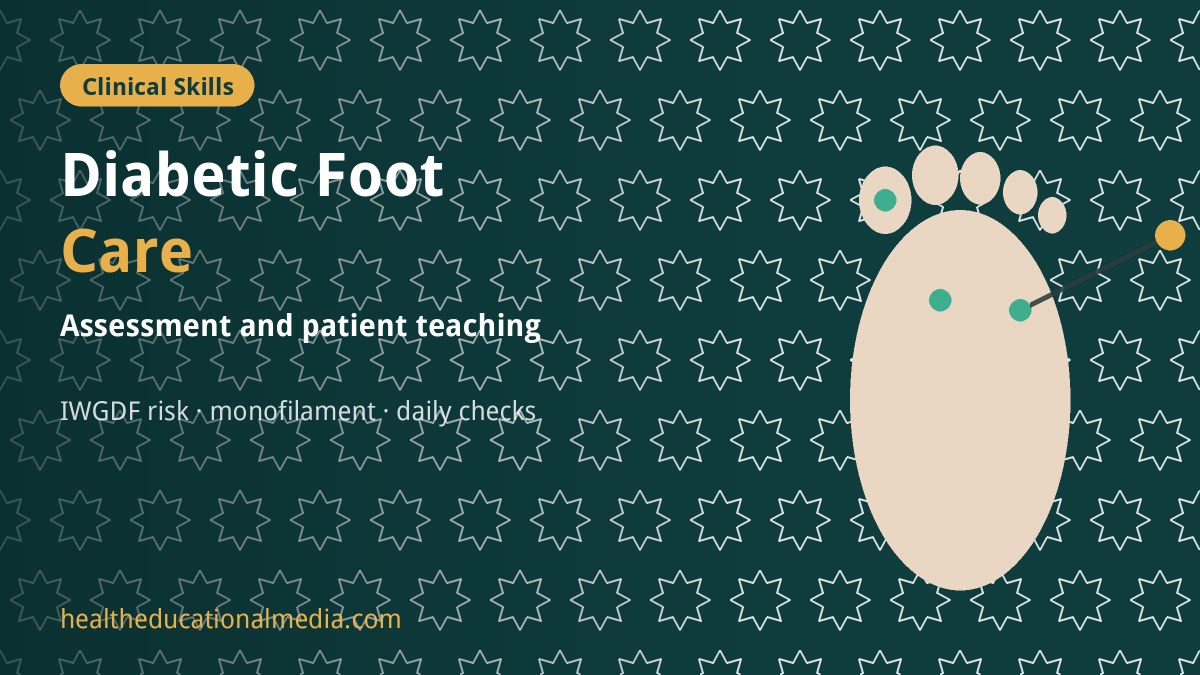
Table of Contents
Why feet are at risk in diabetes
- Loss of protective sensation (LOPS): nerve damage means injuries go unnoticed.
- Peripheral artery disease (PAD): poor blood flow slows healing.
- Foot deformity: raised pressure points form calluses and then ulcers.
- Infection risk: high blood glucose weakens the body’s defences.
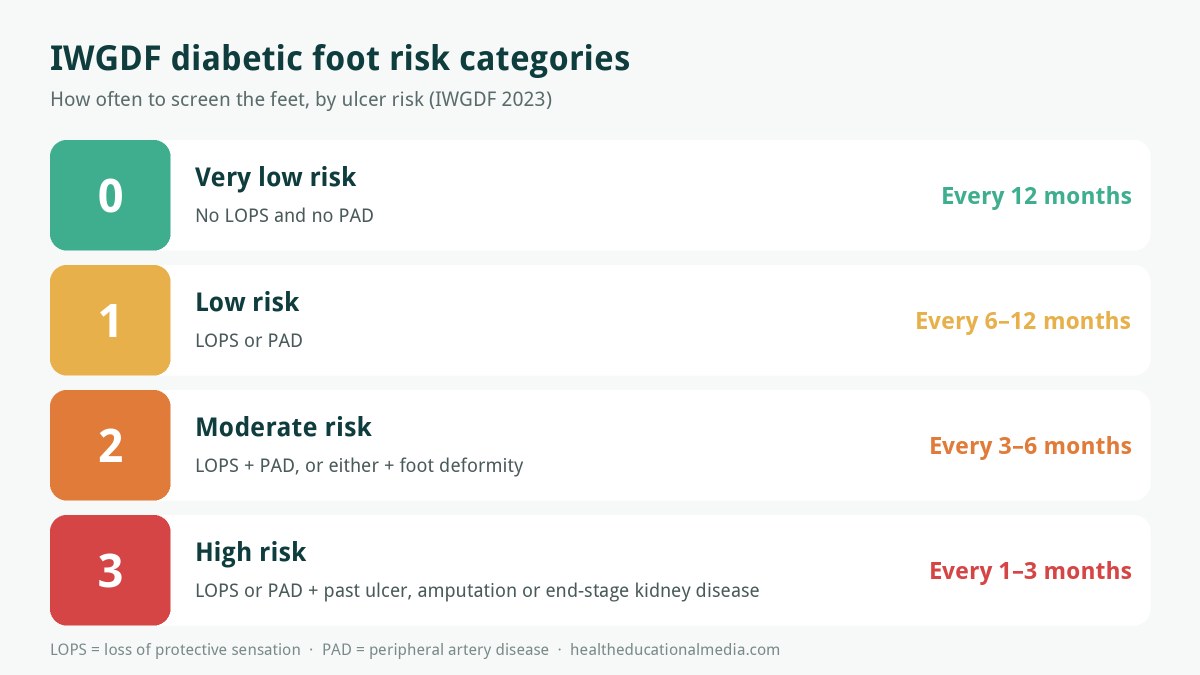
IWGDF risk categories and screening frequency
| Category | Ulcer risk | Findings | Screen every |
|---|---|---|---|
| 0 | Very low | No LOPS and no PAD | 12 months |
| 1 | Low | LOPS or PAD | 6–12 months |
| 2 | Moderate | LOPS + PAD, or LOPS + deformity, or PAD + deformity | 3–6 months |
| 3 | High | LOPS or PAD plus a past ulcer, amputation or end-stage kidney disease | 1–3 months |
IWGDF notes these intervals are based on expert opinion. Higher-risk patients also need foot-care education and properly fitting, protective footwear.
Diabetic foot assessment: step by step
- History: past ulcer or amputation, kidney disease, pain on walking, numbness or burning.
- Skin: dryness, cracks, calluses, blisters, redness, fungal infection between the toes.
- Nails: thick, ingrown or poorly cut nails.
- Shape: hammer toes, bunions, collapsed arch.
- Circulation: palpate dorsalis pedis and posterior tibial pulses; note cold, pale or hairless skin.
- Sensation: monofilament or Ipswich touch test (below).
- Footwear and socks: fit, rough seams, foreign objects inside.
Record your diabetic foot care nursing findings clearly; a standard format helps. Our Nursing Care Plan (Medical Ward) Format and Community Adult Care Format are built for this.
Testing sensation: monofilament and Ipswich touch test
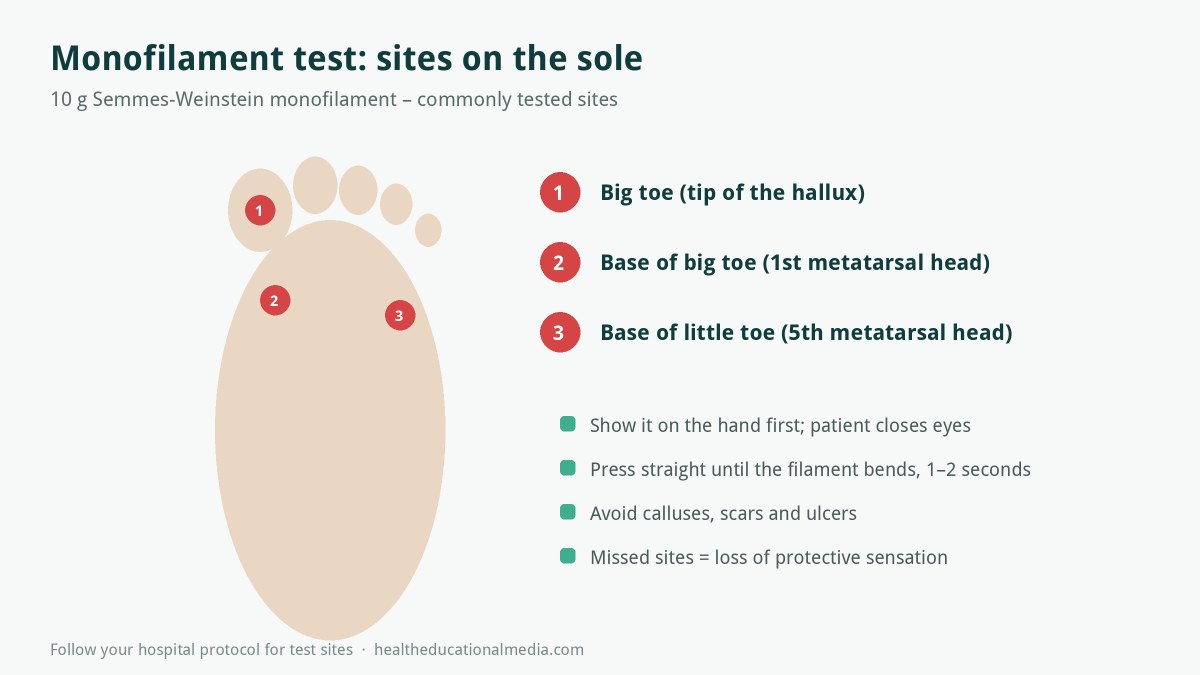
IWGDF recommends checking loss of protective sensation with a 10 g Semmes-Weinstein monofilament. If one is not available, the Ipswich touch test is an accepted alternative.
- Explain the test and show it first on the patient’s hand.
- Ask the patient to close their eyes and say “yes” when they feel the touch.
- Press the monofilament straight onto the skin until it bends, for about one to two seconds, on the test sites of the sole; avoid calluses and ulcers.
- For the Ipswich touch test, lightly touch the tips of the first, third and fifth toes for one to two seconds.
- Missed sites suggest loss of protective sensation; record and refer as per protocol.
Daily foot care teaching for patients
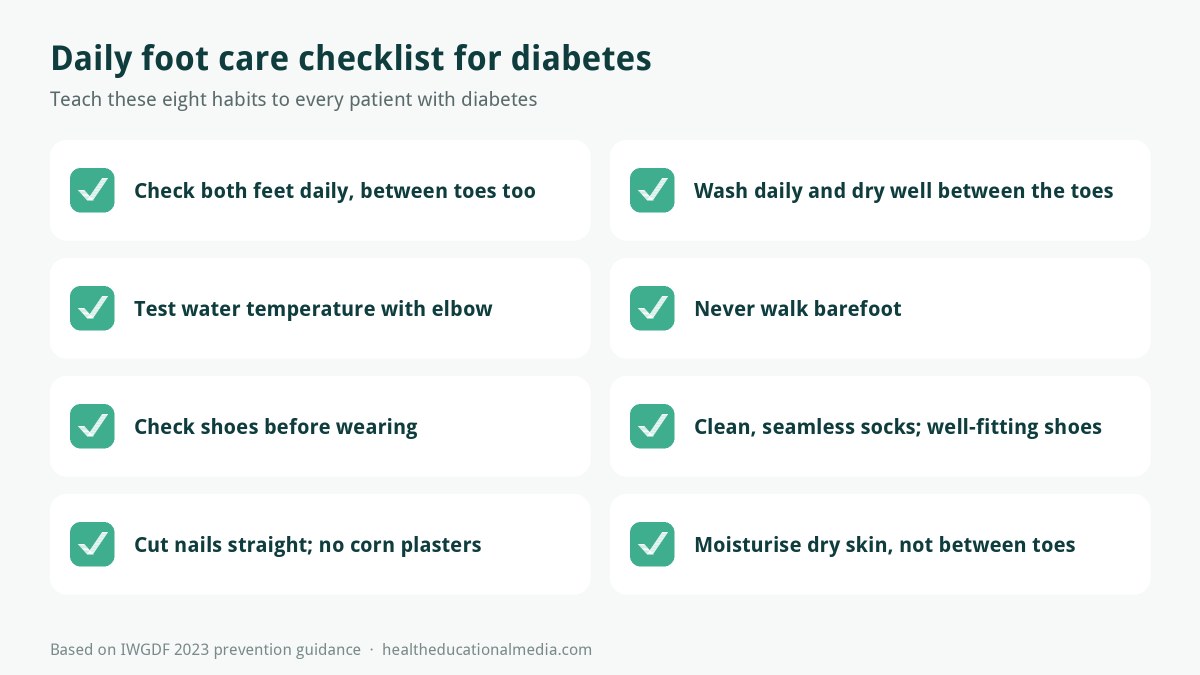
- Look at both feet every day, including between the toes. Use a mirror or ask a family member.
- Wash feet daily and dry carefully, especially between the toes.
- Check bath water with the elbow or a thermometer; numb feet cannot sense heat.
- Never walk barefoot, even at home or on hot ground outside; wear soft, protective footwear.
- Shake out and check shoes before wearing; choose well-fitting shoes and clean, seamless socks.
- Cut nails straight across; do not cut corns or use chemical corn plasters.
- Use moisturiser for dry skin, but not between the toes.
- Keep blood glucose, blood pressure and follow-up visits on track.
Red flags: when to refer urgently
Refer the same day for any open wound or ulcer, new redness, swelling or warmth, pus or bad smell, black or blue skin, sudden pain or fever. In diabetes, small foot problems can worsen within hours.
Wound care must follow medical orders and asepsis. Revise aseptic technique, and see our evidence review on honey for wound healing, which explains why diabetic foot ulcers need the doctor’s plan.
Wudu and foot care
Muslim patients wash their feet during wudu several times a day. Nurses can use this habit: encourage patients to look at their feet each time, dry well between the toes afterwards, and avoid very hot water. A daily act of worship becomes a daily foot check.
Frequently asked questions
What is diabetic foot care nursing?
It is the nursing assessment, risk screening, patient teaching and early referral that prevent foot ulcers and amputations in people with diabetes.
How often should a diabetic foot be screened?
IWGDF suggests every 12 months for very low risk, 6–12 months for low, 3–6 months for moderate and 1–3 months for high risk.
What is the monofilament test?
A 10 g Semmes-Weinstein monofilament is pressed on the sole until it bends. If the patient cannot feel it, they have lost protective sensation.
Can people with diabetes walk barefoot?
No. IWGDF advises at-risk people not to walk without suitable foot protection, indoors or outdoors.
Five minutes of diabetic foot care nursing at each visit can save a limb, so make it part of every diabetes check. Look, feel, teach and refer early.
Sources: IWGDF 2023 guidelines on prevention of foot ulcers (PubMed); IWGDF guidelines. Checked on 4 November 2026. Follow your hospital’s protocol in practice.
Educational Disclaimer
The information in this article is provided for educational and informational purposes only, aimed at students and faculty in Nursing, Medical, Paramedical, and allied Health Science programmes. It is not medical advice, diagnosis, or treatment, and must not replace guidance from a qualified physician, nurse, or licensed healthcare professional.
While we review all content carefully and align it with recognised syllabi (INC, RGUHS, state nursing councils), medical knowledge evolves rapidly. Always verify clinical procedures, drug doses, and protocols against your institution's current guidelines before applying them in patient care.
For complete terms, see our Disclaimer. Found an error? Let us know.
You May Also Read
National Newborn Week 2026: Essential Newborn Care Every Nurse Should Know
National Newborn Week is 15–21 November. A simple guide to essential newborn care: the first hour, warmth, breastfeeding, vitamin K, birth vaccines, HBNC visits and danger signs.
Honey for Wound Healing: Tibb-e-Nabawi Wisdom and Modern Nursing Evidence
What the Qur'an and Sunnah say about honey, what the Cochrane review found about honey for wound healing, and the safety rules every nurse must follow.
Nursing Case Study Format: How to Write One, with a Sample and Common Mistakes
A clear nursing case study format for B.Sc, GNM and Post Basic students: every section explained, a short worked sample on pneumonia, marking tips and common mistakes.

HEALTH PLANNING, POLICIES AND PROBLEMS – INDEX
Get simplified nursing notes on India's health planning, policies, and health-related challenges. Ideal for B.Sc and GNM students in Community Health Nursing.