World Pneumonia Day 2026 falls on 12 November. In India, pneumonia is still the leading infectious killer of children under five, and nurses, ANMs and ASHAs are often the first to spot it.
This guide covers the danger signs, India’s SAANS campaign, the PCV schedule, oxygen rules and the nurse’s role in care and prevention, using the Ministry of Health’s official guidance.
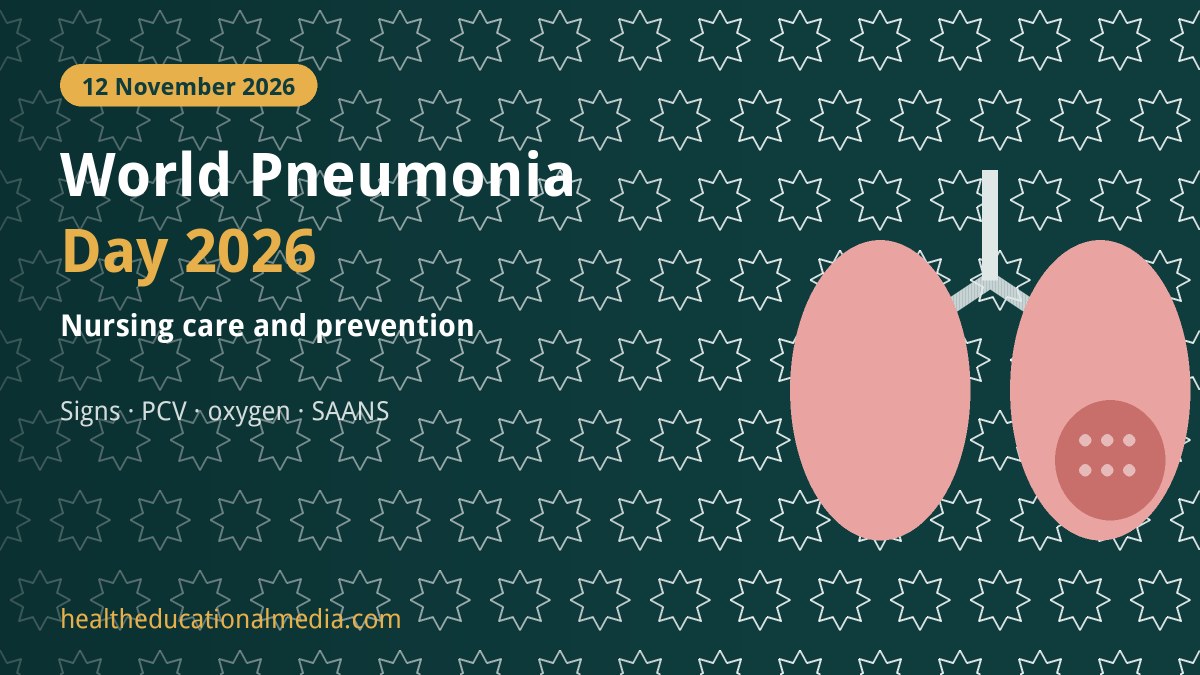
Table of Contents
Why World Pneumonia Day 2026 matters in India
According to MoHFW’s SAANS 2025 guidance note:
- pneumonia causes about 16% (16.31%) of deaths in children under five in India
- around 30 million episodes of acute respiratory infection or pneumonia occur each year
- about 3 million of these (10%) are severe
Most of these deaths can be prevented with vaccination, breastfeeding, early detection and timely antibiotics and oxygen.
What is the SAANS campaign?
SAANS stands for Social Awareness and Action to Neutralize Pneumonia Successfully. Its tagline is “Pneumonia nahi, toh bachpan sahi.” The 2025–26 round was launched on World Pneumonia Day, 12 November 2025.
- follow the National Childhood Pneumonia Management Guidelines (2019)
- raise community awareness on protection, prevention and treatment
- find and treat suspected pneumonia early in children under five
- strengthen facility care for severe pneumonia, including oxygen
Danger signs in children
Count breathing for a full minute while the child is calm. Fast breathing is defined by age:
| Finding | Cut-off / meaning | Action |
|---|---|---|
| Fast breathing, 2–12 months | 50 or more breaths per minute | Treat and follow up as per guidelines |
| Fast breathing, 12 months–5 years | 40 or more breaths per minute | Treat and follow up as per guidelines |
| Chest indrawing | Danger sign | Urgent referral after the first dose of oral amoxicillin |
| SpO2 below 90% | Hypoxaemia | Urgent referral; give oxygen |
| SpO2 90% to below 94% | Needs assessment | Refer for assessment |
Also refer at once if a child cannot drink or breastfeed, vomits everything, has convulsions, or is unusually sleepy or hard to wake.
Prevention: PCV and healthy habits
The pneumococcal conjugate vaccine (PCV) is free under the Universal Immunization Programme:
| Dose | Age |
|---|---|
| PCV 1 | 6 weeks |
| PCV 2 | 14 weeks |
| PCV booster | 9 months |
- Exclusive breastfeeding for the first six months, then good complementary feeding.
- Hand washing with soap, especially before feeding and after using the toilet.
- Clean indoor air: reduce smoke from biomass fuel and tobacco, and keep homes ventilated.
- Complete all vaccines on time, not only PCV.
Revise the cold chain and the nurse’s role in vaccination in our immunization guide.
Nursing care of a child with pneumonia
- Assess respiratory rate, chest indrawing, SpO2, temperature, feeding and level of alertness.
- Pre-referral care: as per guidelines, give the first dose of antibiotic before transferring a child with danger signs.
- Oxygen: give oxygen when SpO2 is below 90% (or below 94% with other emergency signs) and keep it above 90%. Nasal prongs are preferred for young infants.
- Feeding and fluids: keep breastfeeding; give small, frequent feeds.
- Fever: monitor temperature and give antipyretics as prescribed.
- Teach the family danger signs, how to give medicines and when to come back.
Nursing care of an adult with pneumonia
- Semi-Fowler’s position to ease breathing
- Deep breathing and coughing exercises to clear secretions
- Oxygen and antibiotics exactly as prescribed, on time
- Oral fluids as allowed; monitor intake and output
- Monitor respiratory rate, SpO2, temperature and level of consciousness, and report any worsening
See a worked pneumonia care plan in our nursing case study format guide.
World Pneumonia Day activities for nursing students
- A health talk for mothers on danger signs and breastfeeding
- A demonstration of counting a child’s breathing for one full minute
- A vaccination card check drive in your field practice area
- A poster on clean indoor air and hand washing
Use these formats from our marketplace for your community postings: Community Under Five Care Format, Community Infant Care Format and Health Talk Format. For background, read our maternal and child health guide.
Frequently asked questions
When is World Pneumonia Day 2026?
World Pneumonia Day is observed every year on 12 November.
What is the SAANS campaign?
SAANS (Social Awareness and Action to Neutralize Pneumonia Successfully) is MoHFW’s campaign to protect, prevent and treat childhood pneumonia. The 2025–26 round began on 12 November 2025.
What is fast breathing in children?
50 or more breaths per minute for infants aged 2–12 months, and 40 or more for children aged 12 months to 5 years.
When is PCV given in India?
Under the Universal Immunization Programme, PCV is given at 6 weeks, 14 weeks and a booster at 9 months.
Use World Pneumonia Day 2026 to teach one family the danger signs. That small step can save a child’s life.
Source: Ministry of Health and Family Welfare, SAANS 2025 Guidance Note. Checked on 31 October 2026. Follow your state’s current SAANS guidelines in practice.
Educational Disclaimer
The information in this article is provided for educational and informational purposes only, aimed at students and faculty in Nursing, Medical, Paramedical, and allied Health Science programmes. It is not medical advice, diagnosis, or treatment, and must not replace guidance from a qualified physician, nurse, or licensed healthcare professional.
While we review all content carefully and align it with recognised syllabi (INC, RGUHS, state nursing councils), medical knowledge evolves rapidly. Always verify clinical procedures, drug doses, and protocols against your institution's current guidelines before applying them in patient care.
For complete terms, see our Disclaimer. Found an error? Let us know.
You May Also Read
World Diabetes Day 2026: Early Action on Diabetes and the Nurse’s Role
World Diabetes Day 2026 (14 Nov) focuses on early action. Learn India's diabetes figures, NP-NCD screening, warning signs, diagnostic values, hypoglycaemia care and how nurses can lead early action.
Kayakalp Day 2026 in Nursing Colleges: INC Notice and a Ready One-Day Plan
INC has asked nursing institutions to hold a one-day Kayakalp (sanitation and hygiene) activity on 27 October 2026 under Special Campaign 6.0. Here is what Kayakalp is, a ready one-day plan and a checklist.
Top Global Organizations Powering Community Health Nursing Success
Explore how WHO, UNFPA, UNDP, and the World Bank shape and strengthen Community Health Nursing through their global initiatives and partnerships.
Epidemiology: Disease Distribution, Models & Uses for B.Sc Nursing (5th Sem)
Explore epidemiology’s role in nursing with insights into disease distribution, epidemiological models, and public health applications for 5th-semester B.Sc Nursing students.