Every year, India observes National Newborn Week from 15 to 21 November. For National Newborn Week 2026, the message for nurses is simple: the first few minutes, hours and days decide a lot for a baby.
India has made good progress. As per MoHFW’s newborn week guidance, our neonatal mortality rate came down from 44 per 1,000 live births in 2000 to 19 in 2023. But 19 is still too high, and most of these deaths can be prevented with basic, careful care. This post explains that care in plain words.
Table of Contents
What is National Newborn Week?
National Newborn Week 2026 is a week set aside by the Ministry of Health and Family Welfare to push newborn care across hospitals and villages. Last year’s theme was “Newborn Safety: Every touch, Every time, Every Baby”, with focus on infection prevention and zero harm in newborn care units (MoHFW guidance note 2025). Check your state NHM circular for the 2026 theme.
Essential newborn care in the first hour
Doctors and nurses often call this the “golden hour”. For a normal baby who cries well at birth, follow these steps in order:
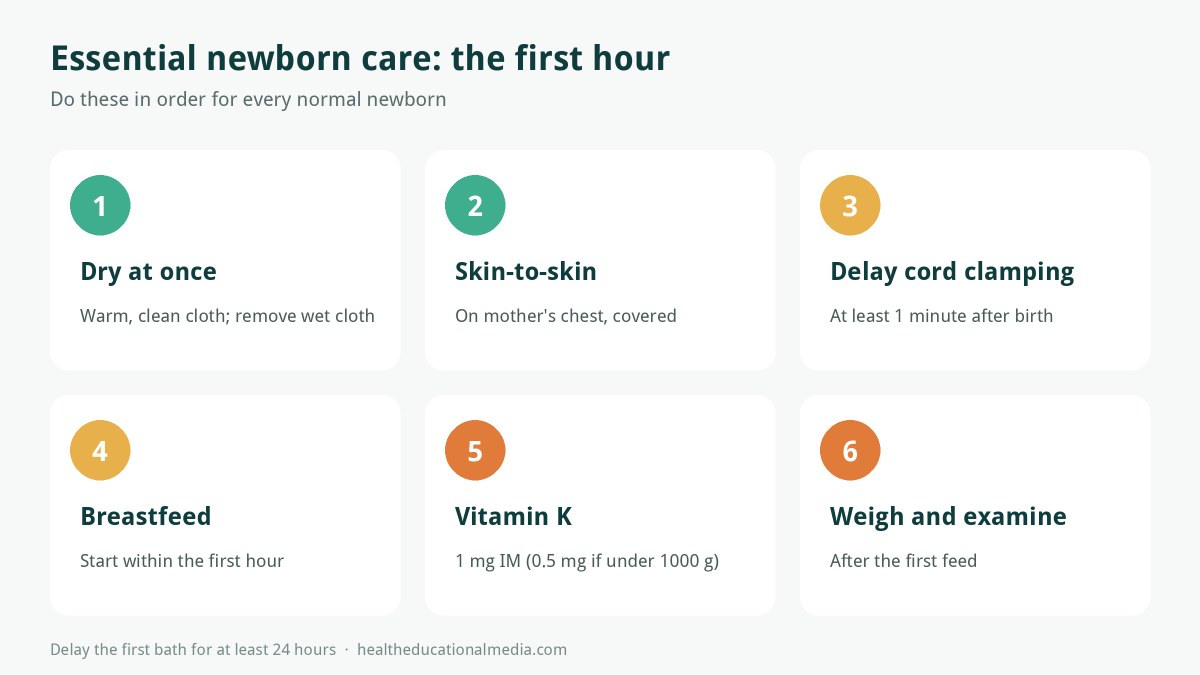
- Dry the baby immediately with a warm, clean cloth. Remove the wet cloth.
- Skin-to-skin contact on the mother’s chest, covered with a dry cloth and cap.
- Delay cord clamping for at least one minute.
- Start breastfeeding within the first hour.
- Give vitamin K and examine the baby.
- Weigh the baby after the first feed, not before.
Many Muslim families say the adhan softly in the baby’s ear soon after birth. This fits easily with skin-to-skin care, so there is no need to separate mother and baby for it.
Keep the baby warm
A newborn loses heat very fast, especially from the head. Cold babies feed poorly and fall sick quickly. Normal temperature is about 36.5–37.5 °C.
- Keep the room warm and free from draught.
- Cap, socks and loose layers; keep the baby with the mother.
- Delay the first bath for at least 24 hours.
- For small or preterm babies, use Kangaroo Mother Care as advised.
Breastfeeding: early and only breast milk
The first yellowish milk, colostrum, is very rich in protection. Help the mother start within one hour, and continue only breast milk for six months.
Gently stop old practices: no ghutti, water, sugar water or honey before or along with breast milk. Honey can cause infant botulism and should never be given under one year. Read why in our post on honey and its safety rules.
Vitamin K and birth-dose vaccines
- Vitamin K: 1 mg intramuscular (0.5 mg if birth weight is below 1000 g), as per national newborn care guidelines. It prevents bleeding in the first weeks.
- At birth vaccines (UIP): BCG, OPV-0 and the Hepatitis B birth dose, which should be given within 24 hours.
Revise vaccine handling and the cold chain in our immunization guide.
Cord and eye care
- Keep the cord clean and dry. Do not apply oil, ash, cow dung or any home remedy.
- Fold the nappy below the cord so it stays dry.
- Clean each eye with clean, boiled and cooled water, using a separate swab, from the inner corner outwards.
HBNC: ASHA home visits
Care does not stop at discharge. Under Home Based Newborn Care (HBNC), the ASHA visits the baby at home:
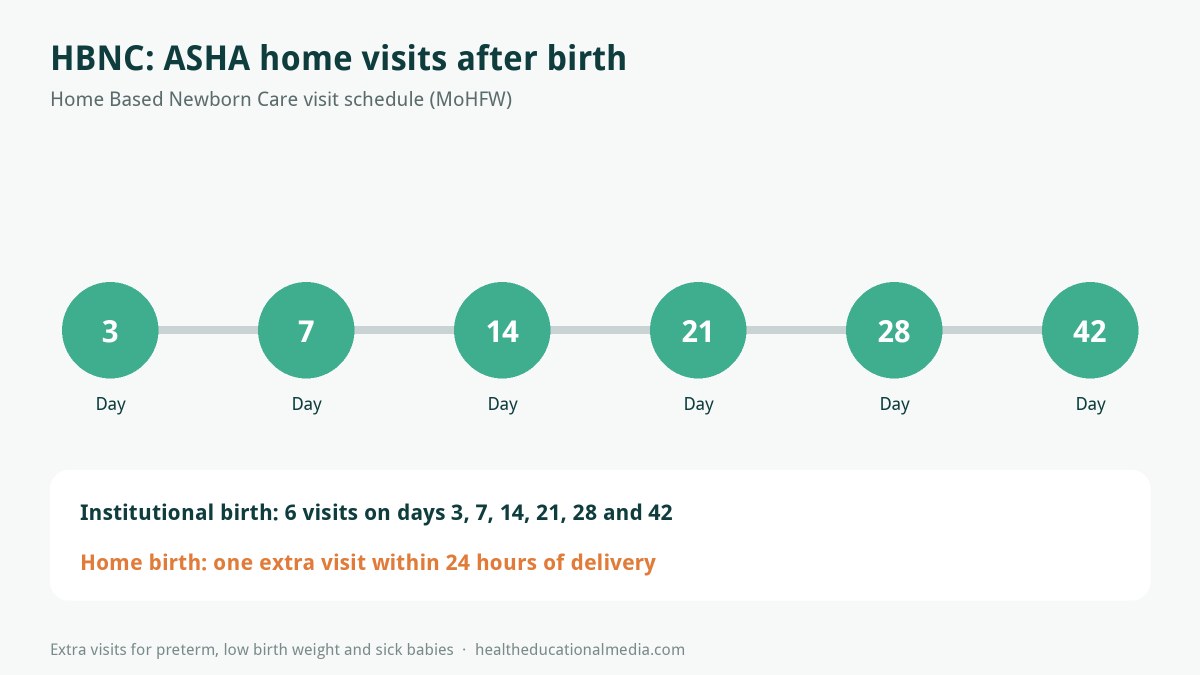
- Institutional delivery: six visits on days 3, 7, 14, 21, 28 and 42.
- Home delivery: one extra visit within 24 hours of birth.
- Extra attention for preterm, low birth weight and sick babies discharged from SNCU.
Newborn danger signs
During National Newborn Week 2026, teach every mother these signs before she goes home. Any one of them means the baby must be taken to a hospital at once.
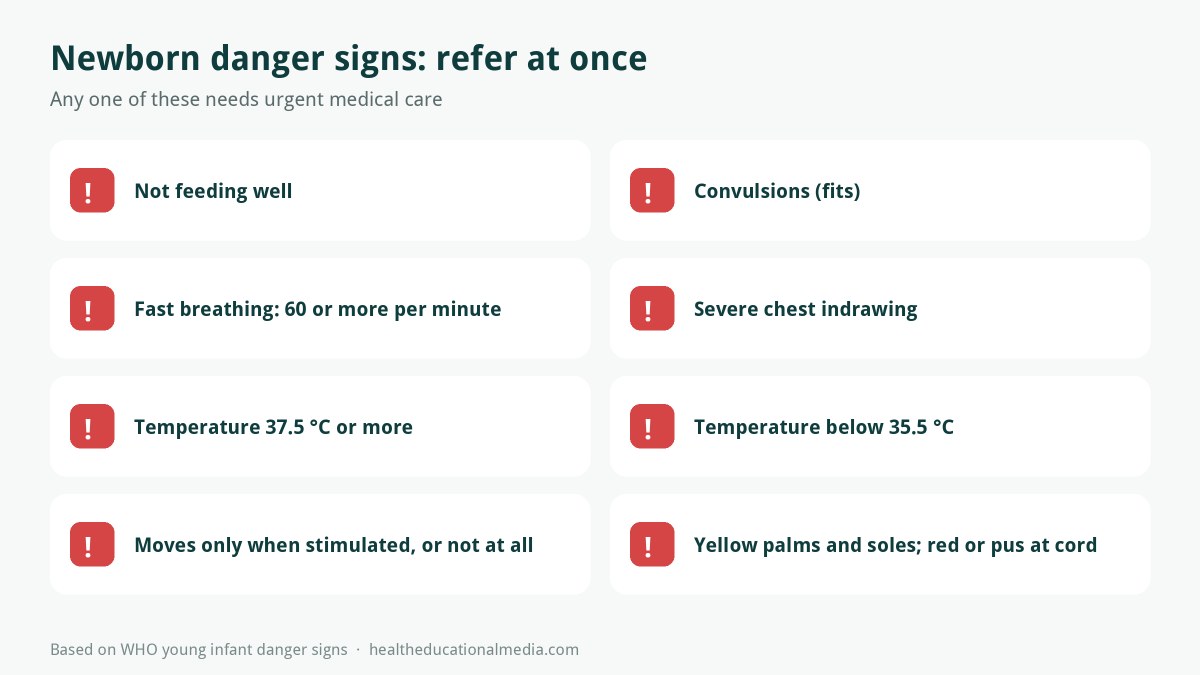
- Not feeding well
- Convulsions (fits)
- Fast breathing: 60 or more breaths per minute
- Severe chest indrawing
- Temperature 37.5 °C or more, or below 35.5 °C
- Moves only when touched, or does not move at all
- Yellow palms and soles, or redness and pus around the cord
Fast breathing and chest indrawing can also be pneumonia. See our World Pneumonia Day guide for the SAANS rules on breathing rate and oxygen.
What nursing students can do this week
- Take a health talk for mothers in the postnatal ward on danger signs and breastfeeding.
- Join an ASHA on HBNC visits in your community posting.
- Practise drying, wrapping and temperature checks on the skills-lab mannequin.
- Check that every baby in your ward got vitamin K and birth-dose vaccines.
For your records, use our Normal Childbirth Documentation Format, Community PNC Format and Community Infant Care Format. For background, read our maternal and child health guide.
Frequently asked questions
When is National Newborn Week 2026?
National Newborn Week is observed in India every year from 15 to 21 November.
What is essential newborn care?
It is the basic care every baby needs at birth: drying, warmth, skin-to-skin contact, delayed cord clamping, early breastfeeding, vitamin K, cord and eye care, and birth vaccines.
When should a newborn get the first bath?
Delay the first bath for at least 24 hours to protect the baby from getting cold.
What are the HBNC visit days?
For institutional births, ASHAs visit on days 3, 7, 14, 21, 28 and 42. After a home birth, there is one extra visit within 24 hours.
This National Newborn Week 2026, do the basics well and teach one mother the danger signs. That is how we bring 19 down further.
Sources: MoHFW National Newborn Week guidance note 2025; MoHFW HBNC portal; WHO recommendations on newborn health. Checked on 4 November 2026. Follow your hospital’s protocol in practice.
Educational Disclaimer
The information in this article is provided for educational and informational purposes only, aimed at students and faculty in Nursing, Medical, Paramedical, and allied Health Science programmes. It is not medical advice, diagnosis, or treatment, and must not replace guidance from a qualified physician, nurse, or licensed healthcare professional.
While we review all content carefully and align it with recognised syllabi (INC, RGUHS, state nursing councils), medical knowledge evolves rapidly. Always verify clinical procedures, drug doses, and protocols against your institution's current guidelines before applying them in patient care.
For complete terms, see our Disclaimer. Found an error? Let us know.
You May Also Read
Diabetic Foot Care Nursing: Assessment, Risk Levels and Patient Teaching
A practical diabetic foot care nursing guide: IWGDF risk categories, how to assess the foot, the monofilament test, daily self-care teaching and when to refer.
Nursing Case Study Format: How to Write One, with a Sample and Common Mistakes
A clear nursing case study format for B.Sc, GNM and Post Basic students: every section explained, a short worked sample on pneumonia, marking tips and common mistakes.

HEALTH PLANNING, POLICIES AND PROBLEMS – INDEX
Get simplified nursing notes on India's health planning, policies, and health-related challenges. Ideal for B.Sc and GNM students in Community Health Nursing.

Top Health Committees & Planning in India: Powerful Nursing Notes (2024)
These nursing notes simplify India’s health planning journey, major committees, and recommendations—designed for B.Sc and GNM students studying Community Health Nursing.