
Table of Contents
“Digital Selling ” India’s digital commerce market crossed USD 185 billion in 2026 and is on course to reach USD 740 billion by 2036. Behind that number sits a simple question: what does it take for a student, a faculty member, or a healthcare professional to actually earn from it? This guide answers that — with real numbers, current government rules, exact tax provisions, and a step-by-step path to your first digital sale.
Last updated: 18 September 2026. Every statistic and rule cited below has a linked source at the end of each section.
1. What Is Online Digital Selling?
Online digital selling means offering a product or service to buyers over the internet where discovery, payment, and (often) delivery all happen digitally. Two broad categories exist:
- Physical goods sold online — books, medical instruments, supplements, uniforms, lab consumables. The order is digital; the delivery is a courier.
- Digital goods and services — e-books, PDFs, study notes, PPT decks, online courses, consultations, software. Everything is downloaded or streamed. Zero shipping cost, near-zero unit cost.
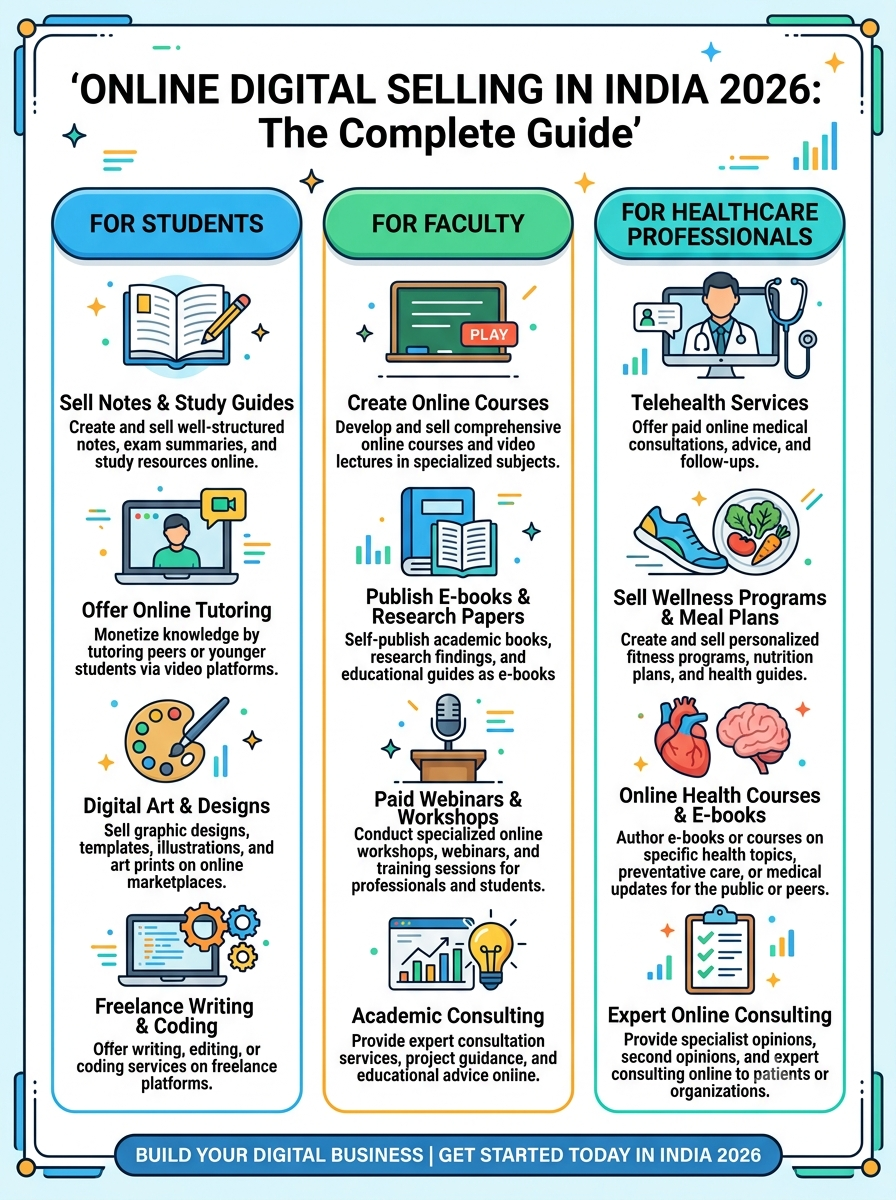
For students, faculty, and healthcare professionals, the second category is where margins are highest and entry is easiest — you already have the raw material (notes, PPTs, expertise). India’s tax law calls these OIDAR services (Online Information Database Access and Retrieval), and they carry specific GST and income-tax treatment covered in Section 6.
2. Market Size & Current Status (2026)
The numbers matter because they show where the demand actually is. Here is the current state of the Indian digital economy:
India Digital Economy Snapshot — 2026
- Total e-commerce GMV FY 2025–26: Crossed ₹12 lakh crore, growing at 18–20% CAGR (SaaSultra, March 2026).
- UPI dominance: UPI now handles 73% of e-commerce payments; COD has fallen to 18% (Growzai India E-commerce Stats 2026).
- Mobile-first: 82% of e-commerce transactions happen on smartphones. If your product doesn’t work on mobile, it doesn’t work.
- D2C boom: Over 800 D2C brands in India now cross ₹100 crore in annual revenue — selling direct instead of through Amazon/Flipkart.
Sources: Mordor Intelligence India E-commerce Market 2026; Future Market Insights India Digital Commerce Market 2026; NPCI UPI December 2024 statistics; CSEP India E-commerce Report 2026.
3. Digital Selling in Healthcare & Education
The India EdTech market is one of the fastest-growing digital segments — valued at USD 7.5 billion in early 2026, projected to cross USD 33 billion by 2034 at a 27.94% CAGR (IMARC Group; Equity Edge Research). India is the second-largest EdTech market in the world after China.
Within EdTech, three sub-segments are particularly relevant for healthcare education:
| Segment | Market Share (2025) | What Sells |
|---|---|---|
| K-12 supplements | 43% | Chapter notes, MCQ banks, revision sheets |
| Test prep (NEET, NORCET, GNM entrance) | ~22% | Question banks, mock tests, model papers |
| Higher-ed & upskilling (B.Sc/M.Sc Nursing, MBBS, Paramedical) | ~28% | Unit notes, PPT decks, practical records, case studies |
Why healthcare education is under-served digitally:
- India has 1,706 medical colleges, 3,800+ nursing colleges, 1,600+ pharmacy colleges (National Medical Commission & Indian Nursing Council registers, 2025).
- The total student population across health science programs exceeds 2.4 million, but branded digital study material for course-specific units (Community Health Nursing Unit II, Pharmacology Unit III, etc.) is thin — most content is generic YouTube or scattered PDFs.
- Faculty spend 4–6 hours per week making PPTs, question banks, and practical guides that already exist somewhere — a marketplace for these materials removes duplicated effort.
This gap is the exact reason platforms like Health Educational Media exist — to let students and faculty buy and sell verified, course-mapped, unit-wise materials.
4. Other Sectors Open to Digital Sellers
Beyond healthcare education, these categories are actively growing in 2026:
- Fashion & apparel — 31.67% of Indian e-commerce (Mordor Intelligence 2026). Highest volume but highest competition.
- Beauty & personal care — D2C hotspot; Nykaa, Mamaearth, Sugar Cosmetics all started here.
- Food & beverages — 17.68% CAGR to 2031, fastest-growing category.
- Handicrafts & regional goods — ONDC has boosted this dramatically; artisans now sell directly with 1–3% commission versus 15–25% on Amazon/Flipkart.
- Digital services — design, writing, coding, tutoring, consultation. Zero inventory, highest margin.
5. Government Policies & Programs You Should Know
5.1 Digital India (Ministry of Electronics & Information Technology)
Launched in 2015 and continually expanded, Digital India provides the underlying infrastructure that makes digital selling possible: UPI, Aadhaar-based e-KYC, DigiLocker, Bhashini (translation), and CoWIN-style APIs. Sellers benefit indirectly — no separate registration required.
5.2 ONDC (Open Network for Digital Commerce)
ONDC is a Government of India initiative that lets any seller reach any buyer app — you register once and your product shows up on Paytm, PhonePe, Magicpin, Meesho and more. Key facts:
- Zero registration fee (via Seller Network Participants like eSamudaay, Digiit, SellerApp).
- Commission: 1–3% vs 15–25% on Amazon/Flipkart.
- Coverage: 700,000+ sellers as of 2026 (Mordor Intelligence).
- Official portal: https://ondc.org (registration through partners, not direct).
5.3 MSME Udyam Registration
Any online seller — including D2C brands and digital-service providers — can register as an MSME on the Government’s Udyam portal for free. Benefits include collateral-free credit, priority-sector lending, protection against delayed payments, and access to ₹4+ lakh crore in government procurement via GeM (Government e-Marketplace).
- Portal: udyamregistration.gov.in — the only official site.
- Fee: ₹0. Any site charging fees is unofficial.
- What you need: Aadhaar, PAN, GSTIN (if registered), bank account.
- Time: ~10 minutes; certificate issued instantly.
5.4 Startup India
If you incorporate a Private Limited Company or LLP, DPIIT recognition under Startup India gives you 3-year income-tax exemption (Section 80-IAC), self-certification under labour and environment laws, and a fast-track patent process. Applies to businesses under 10 years old with turnover under ₹100 crore.
6. GST & Income Tax Rules — What You Actually Pay
Tax is where most beginners get anxious. The good news: for small digital sellers, the rules are simpler than you think.
6.1 GST on Digital Goods & Services
| What You Sell | GST Rate | Authority |
|---|---|---|
| Online courses, coaching, digital study material | 18% (9% CGST + 9% SGST) | GST Council Notification 11/2017; confirmed under GST Reforms 2.0 (Sept 22, 2025) |
| Services by recognised educational institution | Exempt | Notification 12/2017-Central Tax (Rate) |
| Software, SaaS, IT services (SAC 998314) | 18% | GST Council |
| Printed books | 0% | GST Schedule I |
| E-books (digital) | 5% | Notification 13/2018-Central Tax (Rate) |
GST registration threshold: Mandatory only when annual turnover exceeds ₹20 lakh (₹10 lakh in special category states) for services. Below this, no GSTIN required. E-commerce platforms may still ask for one — Amazon and Flipkart require GSTIN regardless of turnover; own website / ONDC do not.
6.2 Income Tax — Section 44ADA (Professionals) vs 44AD (Business)
This is the single most important tax provision for small digital sellers. It replaces detailed bookkeeping with a flat presumptive rate.
| Section 44ADA (Professionals) | Section 44AD (Business) | |
|---|---|---|
| Who qualifies | Doctors, nurses billing independently, lawyers, CAs, engineers, IT consultants, interior designers | Traders, D2C sellers, e-commerce sellers of goods, most content creators |
| Presumptive rate | 50% of gross receipts = deemed profit | 6% (digital receipts) / 8% (cash) of turnover = deemed profit |
| Turnover ceiling | ₹50 lakh (₹75 lakh if ≥ 95% receipts digital) | ₹2 crore (₹3 crore if ≥ 95% receipts digital) |
| Books required? | No | No |
| ITR form | ITR-4 (Sugam) | ITR-4 (Sugam) |
| Advance tax | One instalment by 15 March | One instalment by 15 March |
Real example — a nursing faculty selling study materials online:
- Annual receipts: ₹24,00,000 (all via UPI/bank)
- Under Section 44AD (D2C digital goods): 6% × ₹24,00,000 = ₹1,44,000 deemed income
- Under New Tax Regime FY 2025–26, taxable income up to ₹12 lakh enjoys full Section 87A rebate → total tax payable: ₹0
- Only obligation: file ITR-4 by 31 July / 31 August 2026
Sources: Income Tax Act Sections 44AD, 44ADA (as amended by Finance Act 2023); CBDT circulars; TaxAJ Learn Freelancer Income Tax Guide FY 2025–26.
6.3 TDS You’ll See Deducted
- Indian clients on professional fees: 10% under Section 194J
- E-commerce platforms (Amazon, Flipkart) on your sales: 0.1% under Section 194-O
- Both are prepayments — credited to your Form 26AS / AIS at incometax.gov.in and adjusted at ITR filing.
7. Part-Time Digital Earning for Students & Faculty
7.1 For Nursing / Paramedical / Health Science Students
- Sell your unit notes — the ones you already made for your own semester. ₹50–₹200 per unit; if 200 juniors buy over 2 years, that’s ₹10,000–₹40,000 per unit as passive income.
- Solved question banks & MCQs — particularly for NORCET, AIIMS, GNM/ANM entrance, JIPMER, PGIMER. Demand is year-round.
- Case presentation templates & care-plan formats — clinical postings need these constantly.
- Practical record kits — pre-formatted, syllabus-mapped PDFs juniors can customise.
- Peer tutoring (live) — 30-minute video sessions on tough topics via Zoom / Google Meet. ₹200–₹500 per session.
7.2 For Faculty & Educators
- Lecture PPT decks — the ones you already deliver in class. Sell to other institutions and independent learners.
- Question paper sets & model papers — institutions pay well for syllabus-mapped assessments.
- Lesson plans & teaching notes — new faculty desperately need these.
- OSCE / OSPE stations — detailed evaluation checklists.
- Live short courses — 4–6 hour weekend workshops on specific skills (research methodology, biostatistics primer, care plan writing).
7.3 For Healthcare Professionals
- Clinical procedure guides, drug study notes, SOP templates.
- Patient education material — branded to your hospital/clinic if allowed, sold otherwise.
- Online consultation under NMC Telemedicine Guidelines 2020 (still in force) — for registered practitioners.
8. How to Start — A 30-Day Launch Plan for Beginners
Week-by-Week Digital Selling Roadmap
- Pick one product (start narrow: e.g., B.Sc Nursing Sem 6 Unit II notes)
- Convert to clean PDF/PPT
- Watermark with your name
- Write a 100-word product description
- PAN + Aadhaar linked
- Bank account with UPI enabled
- Udyam MSME (free, 10 min)
- GSTIN only if turnover expected > ₹20 L
- List on a specialised marketplace (Health Educational Media, Notesgen, etc.)
- Add product photos / preview pages
- Set price using competitor benchmark × 0.8
- Share the product link in 3 college WhatsApp groups
- Post 1 preview on Instagram/LinkedIn
- Ask 5 buyers for reviews
- Refine title + description based on early data
9. How to Upskill for Digital Selling
Three free/low-cost programs are worth completing before scaling:
- Digital India — Google Digital Unlocked (free, ~40 hours). Covers SEO, digital marketing, analytics. Certified by IAMAI.
- SWAYAM MOOCs (swayam.gov.in) — Ministry of Education. Over 5.8 crore learner enrolments as of 2026; strong content on entrepreneurship and finance.
- Skill India — Digital Skilling (skillindia.gov.in) — sector-specific short courses.
Paid but high-return skills (usually recoverable in 2–3 months of selling):
- Canva Pro for polished product covers & social posts.
- Basic Google Ads or Meta Ads (₹1,000/month test budget).
- Notion or ClickUp to manage product pipeline.
10. Future Scope: Where This Is Heading (2026–2030)
- Market to more than double — India e-commerce projected to reach USD 300–350 billion by 2030 (CSEP Report, July 2026).
- Vernacular content wins — Bhashini API now translates content into 22 official languages, opening Tier-3/4 markets.
- AI-personalised learning — EdTech’s AI-in-education segment growing at 42% CAGR; adaptive study material will replace static PDFs.
- ONDC scale-up — government target of 3 million sellers by 2027 (ONDC 2025 roadmap).
- Creator economy formalisation — Income Tax Act 2025 (effective April 2026) introduces cleaner digital-creator income classifications.
Bottom line for beginners: The next four years are the most favourable window for entering as a small niche seller — infrastructure is built, tax rules are settled, market is expanding, and competition in specialised segments (health science education, for example) is still thin.
11. Frequently Asked Questions
Do I need a GST number to sell online?
Only if annual turnover crosses ₹20 lakh (₹10 lakh for special-category states) for services, or if you sell on Amazon/Flipkart. Own-website and ONDC sales below the threshold require no GSTIN.
Can a college student legally sell online in India?
Yes. Any Indian resident aged 18+ with PAN and Aadhaar can sell as a sole proprietor. Under 18 requires a guardian’s account. Nothing in tax or MSME law restricts students specifically.
What’s the safest platform to start on?
Depends on your product. For health-science study material, specialised platforms (like Health Educational Media) give better discovery than Amazon. For physical goods, Meesho is beginner-friendly with zero registration fee. For digital services, Fiverr and Upwork remain solid.
How much can a beginner realistically earn in year 1?
Honest range: ₹5,000–₹50,000 per month by month 12, depending on niche depth and content quality. Health science education sellers with tight course-specific content tend to outperform generic sellers because their audience is captive (locked to a syllabus).
Is copyright a risk when selling my own study notes?
Your original notes and PPTs are your copyright by default under the Copyright Act 1957. Do not copy verbatim from textbooks — rewrite in your own words and cite. Diagrams from open sources (Wikipedia CC-BY, government documents) are safe to reuse with attribution.
12. Where to Begin
India’s digital selling market has moved past experimentation — the rules are set, the payment rails are national, and the government has cleared the road for small sellers. What remains is execution: pick one product, list it, iterate on the first ten customers, and reinvest earnings into better content.
For health science students and faculty specifically, Health Educational Media is built exactly for this transition — the platform handles category structure (Program → Course → Year → Semester → Unit), payment, GST invoice generation, and discovery. Register as a vendor, upload your first product, and use the roadmap in Section 8.
Buy. Sell. Grow.
Complete Reference List
- Future Market Insights (2026). India Digital Commerce Market Report. futuremarketinsights.com/reports/india-digital-commerce-market
- Mordor Intelligence (2026). India E-commerce Market Share Analysis 2026–2031. mordorintelligence.com/industry-reports/india-ecommerce-market
- CSEP (July 2026). India E-Commerce Report 2026: Innovation in the Merchandise Space. csep.org/reports/india-e-commerce-report-2026
- SaaSultra (March 2026). E-commerce Statistics India 2026: Market Size & Growth. saasultra.com/india-ecommerce-statistics-2026
- Growzai (2026). 40+ E-commerce Statistics India 2026. growzai.com/resources/ecommerce-statistics-india-2026
- NPCI (Jan 2025). UPI December 2024 Transaction Statistics. npci.org.in
- IMARC Group (2026). India EdTech Market Size, Share & Growth Analysis 2034. imarcgroup.com/india-edtech-market
- Equity Edge Research (2026). Industry Report: Education Technology Industry.
- GST Council (Sept 2025). Notification 12/2017 & GST Reforms 2.0. gstcouncil.gov.in
- CBDT. Income Tax Act Sections 44AD & 44ADA (as amended by Finance Act 2023). incometaxindia.gov.in
- Ministry of MSME. Udyam Registration Portal. udyamregistration.gov.in
- ONDC. Open Network for Digital Commerce — Official Site. ondc.org
- Ministry of Education. SWAYAM MOOCs Platform. swayam.gov.in
- DPIIT. Startup India Scheme Details. startupindia.gov.in
- National Medical Commission & Indian Nursing Council. College Registers 2025. nmc.org.in, indiannursingcouncil.org
Article prepared for Health Educational Media — One Platform for Students, Faculty, and All Health Science Institutions.


[…] our full guide to online digital selling in India — short version: under Section 44AD of the Income Tax Act, if all your receipts come through […]